Virginia Revel
The Secret of ChimneysVirginia Revel is a twenty-seven-year-old widow whose striking presence and social connections place her at the intersection of private danger and international intrigue. Her name has been forged on secret letters, her knowledge of Herzoslovakia makes her a crucial witness, and her clear-headed response to a murder brings her into partnership with Anthony Cade. By the end, she has chosen to marry him without knowing that he is Prince Nicholas Obolovitch; his revelation turns their marriage into a possible royal future as well as a personal commitment.
Identity and Background
Virginia is introduced as the Hon Mrs Timothy Revel, formerly Virginia Cawthron, daughter of Lord Edgbaston. At twenty-seven, she is a widow. The narrative emphasizes her tall, slender figure, bronze hair, blue eyes, and expressive face, but her consequential presence is not merely decorative: she is difficult to overlook and has a lively, decisive manner in conversation.
Her experience also extends beyond English society. She spent two years in Herzoslovakia with her husband, who served at the embassy, shortly before the assassination of the king and queen. She knew Prince Michael Obolovitch there and recalls that he had proposed a morganatic marriage. Her firsthand acquaintance with the country and its court later makes her an unusually valuable source of recognition and information.
The Forged Letters and the Murder
Virginia discovers that letters written in her name have become part of a blackmail attempt. When the man confronting her points to the signature, she turns the letter over and sees her own name in a delicate, slanting hand. She reads the letter through before answering him, and understands from its contents what is being threatened. The signature is genuine as a name but false as an act of authorship: someone has used Virginia’s social identity to disguise correspondence between Queen Varaga and King Victor.
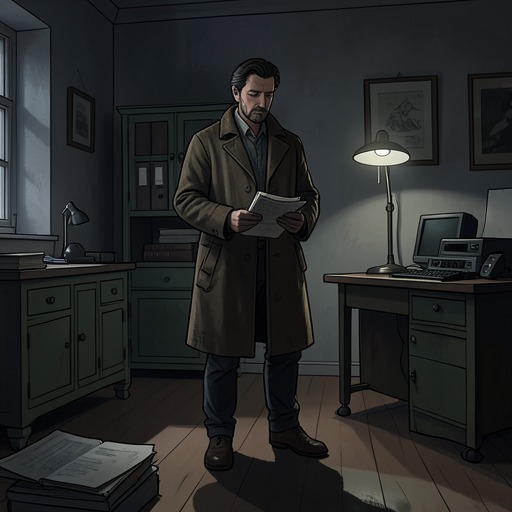
The crisis becomes more immediate when Virginia enters her study expecting a visitor and finds a man in an armchair. At first she takes him for someone who has fallen asleep; she then realizes he is dead. A pistol lies on the floor, and the circumstances make clear that he has been murdered. Virginia remains still as she takes in the discovery, with Elise coming down the stairs nearby.
Rather than conceal the discovery or attempt to handle it alone, Virginia tells Anthony Cade plainly that there is a dead man in the next room and that she does not know what to do. Her candour gives him the facts he needs to begin investigating. She explains the situation quietly and concisely, and he accepts her announcement with composure, volunteering to undertake amateur detective work. The murder thus changes their relation from a chance acquaintance into a working alliance.
Political Knowledge and Independent Judgment
Virginia’s past in Herzoslovakia gives her a perspective that the other people at Chimneys do not share. She knows the country personally, remembers its royal family, and can identify the significance of people and names connected with it. Anthony later recognizes that her presence at the embassy is central to solving the mystery of the impostor who has entered the house party as Mademoiselle Brun.
Her judgment is also independent of the political maneuvering around her. Her cousin George Lomax had proposed that she make herself agreeable to Jimmy McGrath in order to obtain Count Stylptitch’s memoirs. Virginia understood the real purpose beneath Lomax’s talk of English gentlewomen and rejected his attempt to obscure it. Her account reveals both the scheme and her ability to see through euphemism: she can describe the plan as the dishonest extraction of the memoirs rather than accept the respectable language used to dress it up.
When Anthony asks about the letters, Virginia explains that she had not written them. The eventual explanation confirms what she had wondered about: Queen Varaga, while at the Herzoslovakian court, continued to correspond secretly with King Victor. The letters were written in English and signed with the name of an English woman at the embassy—Virginia’s. Their intimate tone made the forged authorship a particularly effective disguise, since a denial from Virginia might not have been believed. The revelation establishes her not as a participant in the conspiracy but as a person whose identity was appropriated to protect it.
Relationships and Cooperation
Virginia’s ties to English political society are both useful and constraining. George Lomax is her cousin, but she does not treat family connection as a reason to endorse his plan. His proposal that she manipulate Jimmy McGrath for the memoirs exposes the pressure placed on her to perform a socially approved role in service of political ends. Virginia recognizes the purpose and speaks of it without accepting its pretence.
She becomes closely allied with Anthony through the murder investigation and the wider inquiry at Chimneys. Her knowledge helps him reconsider the danger posed by the woman presented as Mademoiselle Brun: Virginia had been in Herzoslovakia, and her recognition—or potential recognition—could expose the impostor. Anthony concludes that a plot had been formed to keep Virginia from coming to Chimneys, using a dead body to divert her. The crime’s staging, together with the absence of the Red Hand’s usual mark, suggests a directing intelligence beyond the Comrades of the Red Hand themselves. Virginia’s importance lies partly in what she knows and partly in the threat her recognition poses to a false identity.
Virginia is also cherished by Bill Eversleigh, whose response to her greeting is described as unusually powerful. Their connection is presented through Bill’s devotion, while Virginia’s later intimacy with Lord Caterham is affectionate and companionable: she takes his arm, squeezes it, and tells him she is enjoying her stay. When he asks her to remain at Chimneys after Superintendent Battle lifts the order restricting the guests, she is wanted there by both him and Bundle. These relationships place Virginia within a circle of personal loyalties, distinct from the political schemes that seek to use her.
Marriage and Narrative Significance
At the conclusion, Anthony tells Virginia that he is not a changeling but Prince Nicholas Obolovitch. Virginia reacts with delight and astonishment: she has already married him, and only now learns the royal identity that may alter their future. Anthony proposes that they go to Herzoslovakia and pretend to be king and queen, recalling Jimmy McGrath’s estimate that a monarch there lives, on average, less than four years. Virginia answers that she will love it. The exchange leaves the danger of the country’s politics acknowledged, but it does not make her recoil from the future they might face together.
Virginia’s role brings the novel’s personal and political plots into contact. Her name has been made into cover for a queen’s secret correspondence; her history in Herzoslovakia makes her recognition a danger to an impostor; and her willingness to speak plainly helps turn a murder scene into an investigation. The ending reverses the position in which the conspiracy placed her: instead of remaining a borrowed English signature in other people’s political designs, she becomes the chosen partner of the man who reveals himself as the country’s rightful prince. Her marriage therefore joins intimacy to the prospect of public responsibility, while her response preserves the spirited independence evident from her first appearance.